What Are the Symptoms of PAD?
Quick Facts
- The most common symptom of peripheral artery disease (PAD) in the legs is leg pain during activity.
- Some people with PAD notice other changes in their feet or legs.
- If you have recurring pain, let your health care professional know.
The most common symptom of lower-extremity peripheral artery disease, or PAD, is pain. It may be:
- Described as aching, burning, cramping, discomfort or fatigue
- In the buttock, thigh, calf or ankle
- When walking, exercising or climbing stairs
The pain often goes away after you stop and rest, though it may take a few minutes.
When you move, your muscles need more blood. If an artery is narrowed or blocked, the muscles don’t get enough blood during activity.
The pain, called intermittent claudication, is your body’s warning sign that blood flow isn’t keeping up with what your muscles need.
Many people with PAD have no symptoms. Others think their symptoms are from something else, such as arthritis in the hip, ankle or foot.
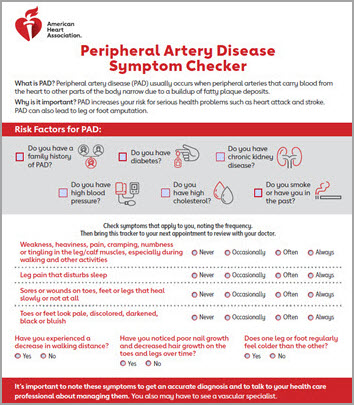
Get our PAD Symptom Checker (PDF) | Spanish (PDF)
What are other symptoms of PAD?
Some people with PAD notice changes in their feet or legs even when they don’t have pain while walking. These symptoms may include:
- Wounds on the feet or toes that heal very slowly or don’t heal at all
- Gangrene, or dead tissue
- A cooler temperature in one foot or lower leg compared with the other
- Slow-growing toenails
- Little or no hair growth on the legs
- Loss of muscle in the calf
- Skin color changes in the legs or feet
- Skin may look pale when the leg is raised
- Skin may look red when the leg is lowered
- Erectile dysfunction, especially in men with diabetes
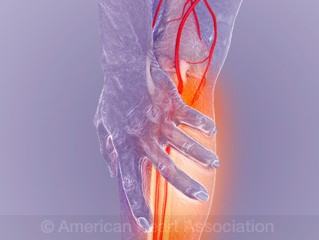
View our interactive library to learn more about PAD and leg pain.
How do health care professionals assess limb risk?
In people with chronic limb-threatening ischemia, a severe type of PAD, health care professionals can use the WIfI classification system to understand how serious the condition is and help guide treatment decisions.
WIFI stands for:
- Wound: How much tissue damage or open sores are present and how much care may be needed to heal them
- Ischemia: How much blood flow to the leg or foot is reduced
- Foot infection: How severe any infection is
After reviewing these factors, your health care professional can:
- Estimate the risk to the limb, including the risk of amputation
- Decide on the best next steps for treatment
Understanding leg pain
Many people think leg pain is a normal part of getting older. You may think it’s from arthritis, sciatica, stiffness or overuse.
For proper diagnosis, consider the source of your pain. PAD leg pain occurs in the muscles, not the joints.
Those with diabetes might confuse PAD pain PAD pain with neuropathy, a common diabetic symptom that’s a burning or painful discomfort of the feet or thighs. If you’re having any kind of recurring pain, speak with your health care professional and describe the pain as accurately as you can.
If you have any of the risk factors for PAD, ask your health care professional about PAD even if you don't have symptoms.
Support that lifts you up

Our online community of patients, survivors and caregivers is here to keep you going no matter the obstacles. We’ve been there, and we won’t let you do it alone.


